The Long Way Was Still the Right Way
Reflections on earning my MBA and finding clarity along the way
As I approached the end of graduate school, I found myself thinking less about the MBA itself and more about the path that brought me to it. Earning this degree is an accomplishment I am incredibly proud of, but it is difficult for me to separate it from a much longer story about education, work, uncertainty, and eventually finding a clearer sense of direction. My academic journey was not linear, and neither was my career. There were years when I viewed that as evidence that I had fallen behind. Looking back now, I see those years differently. I can appreciate that the path I took, including the parts I once wished I could change, ultimately shaped the person who was ready to return to school, finish what he started, and eventually pursue an MBA.
I first went to college believing I would follow the same general sequence I had seen presented as the traditional path into adulthood: earn a degree, begin a career, and continue moving forward from there. Instead, I left college without finishing my undergraduate degree. At the time, I could not fully appreciate how much that unfinished experience would follow me into adulthood. Life continued, and so did I. Throughout my twenties, I worked, found new opportunities, developed professionally, and gradually built a career. I learned how to adapt quickly and prove myself in new environments. I became resourceful and learned to rely heavily on my work ethic, personality, instincts, and ability to learn on the job. There were successes during those years that I remain proud of, and I do not want to diminish them simply because I had not finished college. At the same time, I can now recognize that much of that period was defined by what I would describe as survival mode.
Survival mode, at least in my experience, did not necessarily mean that everything was falling apart. In many ways, I was doing well. The more complicated reality was that I had become focused on keeping myself moving. My career decisions were often influenced by the opportunity immediately in front of me rather than by a clear understanding of what I wanted to build over the long term. I knew how to get the next job, take on more responsibility, learn a new skill, or make myself valuable to an organization. Those abilities allowed me to progress professionally, but they did not automatically give me direction. I spent years becoming better at moving forward before I really understood where I wanted forward to lead.
Not having completed my degree contributed to that mindset. Even as my professional experience grew, there was an awareness that I had left something important unfinished. As the years passed, returning to college became psychologically more difficult because I was no longer simply completing a few remaining requirements. Going back meant confronting the fact that my original plan had not worked out. It meant returning to something I had stepped away from years earlier and accepting that I would finish on a completely different timeline than the one I had imagined when I first enrolled. For a while, it was easier to focus on my career and tell myself that my experience had become more important than the degree. There was some truth in that, but it did not change the fact that finishing still mattered to me.
Eventually, I reached a point where I stopped focusing on when I should have finished and started thinking about whether I still wanted to. That distinction mattered. I could not change the decisions I had made years earlier, and I could not recreate the traditional college experience I once expected to have. What I could do was make a decision based on the person I had become. I decided to return to school and complete my undergraduate degree, not because I wanted to erase the years in between, but because I no longer wanted something unfinished in my past to determine what I believed was possible in my future.
Completing my bachelor's degree changed my relationship with education more than I anticipated. Of course I was proud to finally finish, but the experience also challenged some assumptions I had developed about myself. For years, college had been connected in my mind to something I had not completed. Finishing allowed me to see education differently. Instead of representing an old disappointment, it became evidence that I could return to something difficult with greater maturity and see it through. I also began thinking more seriously about what I wanted from the next stage of my professional life.
That question had become increasingly important because I was unhappy with the direction of my career. I had accumulated years of experience and had taken on increasingly significant responsibilities, but I had also reached the point where I could see the path ahead of me and knew I did not want to continue following it simply because it was familiar. I did not necessarily know what the alternative was. I only knew that being good at my job and being fulfilled by the direction of my career were not the same thing. For someone who had spent much of his twenties focused on staying employed, advancing, and making the most of each opportunity, admitting that I wanted something different was a major shift in perspective.
That desire for a career pivot eventually led me to consider graduate school. I have to laugh at this now because, at the beginning, I did not have a sophisticated understanding of what an MBA was. Business school had never been part of some long-term plan I had created for myself. I was searching for a way to broaden my understanding of business, create more options for my career, and develop skills that could help me move beyond the professional lane I had been traveling in. I wanted a stronger foundation in areas I had encountered throughout my career but had largely learned through experience. More than anything, I was looking for direction.
Once I began the MBA, I quickly realized that pursuing it would require a different level of commitment than simply deciding I wanted another degree. I was working full time and attending school full time, which meant that graduate school had to fit around a professional life that was already demanding. To make matters more difficult, I was spending my days in a job that I had grown to hate. There was something particularly challenging about working all day in an environment that reinforced my desire for change and then immediately transitioning into coursework that I hoped would help me create that change. I often finished work mentally exhausted and still had several hours of academic work ahead of me.
My schedule during that period became extremely disciplined. Evenings that previously belonged to me were devoted to coursework, and weekends became essential academic time. There were papers, case studies, presentations, exams, discussion posts, quantitative assignments, simulations, spreadsheets, team projects, and group meetings to manage. My social life became extremely limited because there simply were not enough hours available to maintain the same lifestyle while working and attending school full time. I missed events, declined invitations, and spent more weekends at my computer than I would ever care to count. I had to become protective of my time in a way that I had never been before.
I do not want to romanticize that experience now that it is over. There is a tendency to look back on difficult accomplishments and make every sacrifice sound rewarding in retrospect. That would not be an accurate description of my experience. There were periods when I was exhausted and frustrated. There were assignments I did not want to complete and weekends when I desperately wanted to do something other than schoolwork. There were times when I questioned why I had chosen to make an already difficult period of my life even more demanding. Working full time, attending graduate school full time, and maintaining the rest of my responsibilities required sacrifices that I sometimes resented while I was making them.
What surprised me was how much the experience changed my understanding of discipline. Earlier in my life, I often associated accomplishment with motivation or ambition. Graduate school taught me that neither is particularly dependable. Motivation changes from day to day, and ambition alone does not complete an assignment after a difficult workweek. I learned how to work toward something even when I did not feel inspired by the process. I became better at planning my time, prioritizing competing responsibilities, and accepting that some seasons of life require saying no to things you genuinely want in order to make room for something you have decided matters more.
That discipline felt particularly meaningful because of my history with education. I was conscious of the fact that I had once left college without finishing. I did not carry that fact as a source of shame during graduate school, but I was aware of the contrast. The younger version of me had encountered circumstances that led him away from school, while the adult version of me was deliberately building his life around completing it. I had changed, and my circumstances had changed. I had also developed a greater understanding of commitment. Finishing was no longer something I assumed would happen simply because I had started. It was something I was actively choosing, semester after semester.
The academic experience also gave me something I had been searching for professionally. My MBA exposed me to areas of business that allowed me to see my previous experience through a different lens. Studying strategy, analytics, finance, operations, leadership, and people management helped me understand how the different pieces of an organization fit together. Concepts that once felt removed from my day-to-day work became practical tools for evaluating decisions and solving problems. I became more comfortable with quantitative thinking and more deliberate about how I approached complex business questions. Just as importantly, I began to understand that many of the skills I had developed throughout my career were more transferable than I had realized.
The greatest change, however, was not simply academic. Graduate school gave me enough distance from my existing career trajectory to evaluate it more thoughtfully. For years, I had approached career decisions by asking whether I could do a particular job and whether it represented progress. During the MBA, I began asking different questions. I started thinking more seriously about what kinds of problems I wanted to solve, what environments allowed me to do my best work, what kind of impact mattered to me, and what I wanted leadership to look like in the next stage of my career. I became less interested in advancement for the sake of advancement and more interested in alignment between my work, my abilities, and my values.
I would not say that earning an MBA suddenly gave me a perfect plan for the rest of my life. In fact, one of the most valuable things I gained was a healthier understanding of what clarity actually means. I used to think clarity meant knowing exactly what came next. Now I think it is often much simpler. Clarity can mean recognizing that a path you are capable of following is no longer one you want to pursue. It can mean understanding your strengths well enough to imagine applying them somewhere new. It can mean becoming comfortable with uncertainty because you finally trust yourself to make intentional decisions within it.
That realization has made me reconsider the years I once thought of as lost time. When I look back at my twenties now, I can see the limitations of survival mode, but I can also appreciate what those years taught me. I became adaptable because I had to be. I learned how to communicate with different kinds of people, navigate unfamiliar environments, and make myself useful quickly. I learned how organizations function from the inside, often through experience rather than theory. I learned what it feels like to succeed in environments that are not necessarily right for you, which has made me more thoughtful about what success should mean in the future.
The same is true of not finishing college the first time. For years, I viewed that part of my story primarily through the lens of what had gone wrong. Today, I can acknowledge that I wish certain things had happened differently without wishing away everything that happened because they did not. Returning to finish as an adult required me to make an intentional choice that I might have taken for granted when I was younger. Continuing into graduate school required me to expand my understanding of what I was capable of. The experience of finishing became more meaningful precisely because I knew what it felt like to leave something unfinished.
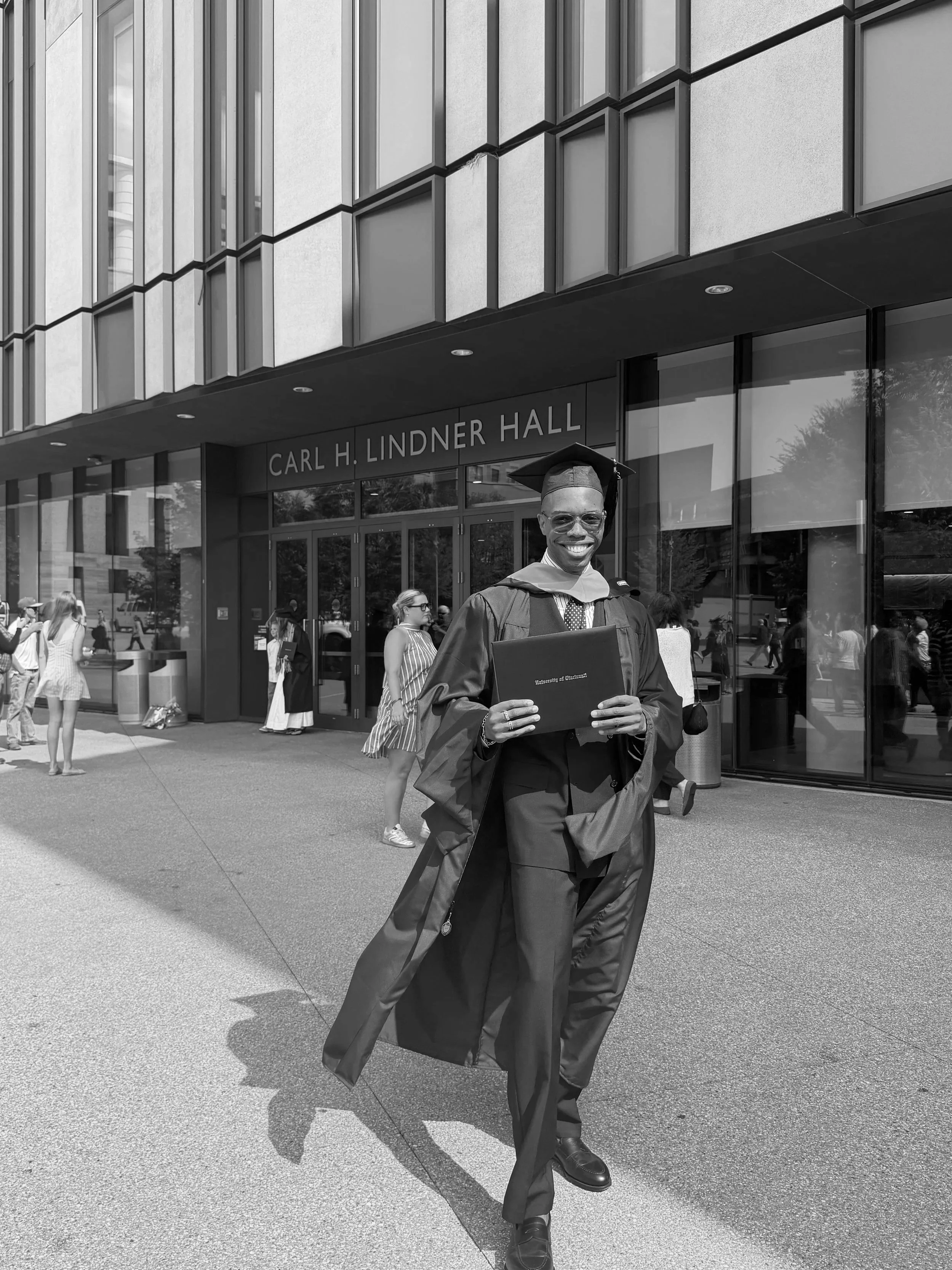
That is why earning my MBA feels significant to me in a way that is difficult to capture by simply talking about the degree. I am proud of the academic accomplishment, and I am proud of the knowledge and skills I gained. I am also proud of the discipline required to work full time and attend school full time, particularly during a period when I was deeply dissatisfied with my professional circumstances. But the MBA represents something larger to me. It sits at the end of a much longer journey from leaving college without a degree to returning years later, finishing my undergraduate education, and then deciding that finishing did not have to be the end of my academic story.
There are years between the sentence "I didn't finish college" and the sentence "I earned my MBA." Those years contain far more of the story than either accomplishment alone. They include jobs I loved and jobs I did not, opportunities that helped me grow, decisions I would make differently today, relationships, disappointments, professional successes, uncertainty, and a great deal of learning that never happened in a classroom. They also contain several different versions of me, each operating with a different understanding of success.
For a long time, I measured my life against the version of the timeline that did not happen. I wondered what my career might have looked like if I had finished college when I originally planned to. I wondered whether I would have found direction earlier or made different professional decisions. Those questions are impossible to answer, and I am finally comfortable leaving them unanswered. Hindsight can make an alternative life appear unusually neat because we never have to live through its complications.
What I know is the life I actually lived. The long route gave me professional experience before I had the academic language to understand some of it. It gave me resilience before I knew how important that resilience would become. It allowed me to experience what it feels like to build a career without a clear sense of direction, which made finding direction more meaningful. It taught me that being capable of surviving something does not obligate me to remain there. Most importantly, it taught me that an unfinished chapter does not have to become the conclusion of the story.
I have also stopped thinking about finishing strong as a way of compensating for not starting perfectly. That interpretation still assumes there was one correct timeline and that my job was eventually to catch up to it. I do not believe that anymore. Finishing strong, for me, means being able to look honestly at the path I took, accept the decisions and circumstances that shaped it, and recognize that I still had the ability to choose what happened next. It means understanding that returning is not the same thing as going backward and that changing direction is not evidence that the previous years were wasted.
As I close this chapter, I am grateful for the MBA, but I am even more grateful for the clarity I found while earning it. I know myself differently than I did when I began. I understand my professional experience differently. I have a clearer sense of what I value, what I am capable of, and what I want from the next phase of my career. I also have much less interest in comparing the timing of my life to anyone else's.
If I could speak to the younger version of myself who left college without finishing, I do not think I would tell him to hurry up. I would not give him a list of everything he needed to fix or warn him that he was falling behind. Knowing what I know now, I think I would simply tell him that his story was going to be longer than he expected. There would be parts of it he would not understand until years later. He would build a career before he fully understood what he wanted from one. He would eventually return to the education he left behind, and when he did, he would bring years of life experience back with him. He would finish his bachelor's degree, continue into graduate school, and discover that the thing he once thought made him late had not disqualified him from going further.
I used to think I needed to make peace with taking the long way because there was nothing I could do to change it. I see it differently now. I can appreciate the long way because I understand what it gave me. It gave me experience, perspective, discipline, resilience, and eventually the clarity to stop simply moving forward and start thinking carefully about where I wanted to go.
I did not take the path I expected when I first started college, and I certainly did not arrive here according to the timeline I once imagined. But I finished what I started, went further than I originally planned, and came out of the experience with a clearer understanding of myself and the life I want to build next.
Looking back now, I no longer see a straight path that I somehow failed to follow. I see my path.
The long way was still the right way.